
When Data-Driven Becomes Data-Distracted

I’ve spent a large part of my career in the world of data. One of the most significant shifts I’ve seen over the years is the corporate obsession with being “data-driven”.
Want to sound like the MVP? Make sure “data-driven” is heard in every meeting. Want to sell an idea? Add a “data-driven” graph. Want to land a job? Pepper your CV with stats you “single-handedly” achieved and make sure to say they came from your “data-driven approach.” If Wall Street were filmed today, Gordon Gekko wouldn’t be saying “Greed is good.” He’d be saying “Data-driven greed is good.” He’d understand the idea of data-informed decisions, but not how to actually select and analyse the data to make them. That’s pretty much where we are today across a lot of domains. We say “data-driven”, while meaning “some numbers were definitely looked at”. Social media, is a particularly good example of data misuse dressed as sophistication.
Social media is built on data. The platforms gamify engagement so effectively that users keep coming back for more. Everything is optimised for the dopamine hit. Then we, the users, start rating ourselves and each other based on what the system highlights: likes, follows, shares, reach. The bigger the numbers, the more credible you’re presumed to be. It’s nonsense, of course. But we all play along. We all feel it. And the more others buy into it, the harder it is to ignore. These metrics may be meaningless, but they’re incredibly persuasive…especially when they’re the only visible signals. They’re not insights. They’re bait.
Over the past few months, I have kept seeing content from the same LinkedIn creator. A startup CEO with around 40,000 followers, pitching themselves as an “Ethical AI Thought Leader”. A popular role on LinkedIn. Also a crowded one. But their content was… everywhere. Every login. Every scroll. It didn’t sit right. The opinions were strong, the tone emotive, the claims sweeping…often framed around AI harming vulnerable groups, and often without much supporting depth. The vibe was less “here’s a balanced take” and more “here’s a carefully engineered emotional provocation piece with a moral headline”. That sort of content always raises a flag for me. So, I decided to pull some data and take a look.
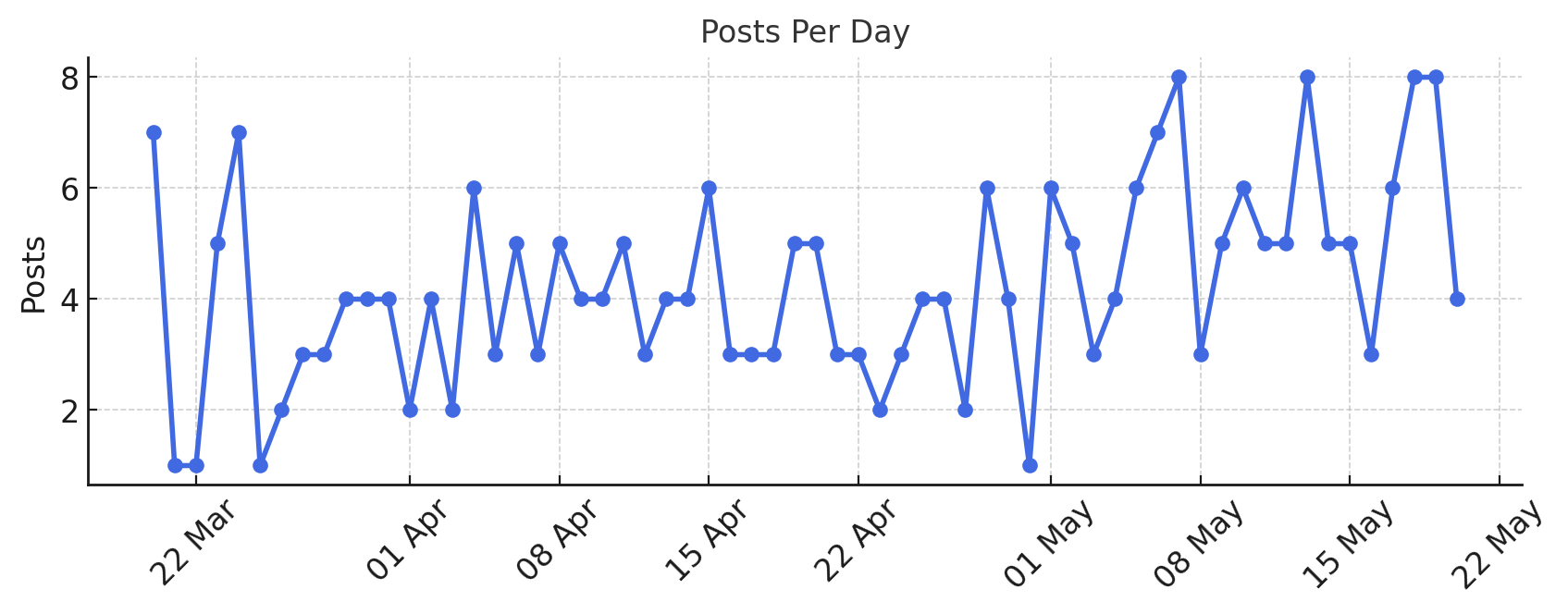 Posts Per Day between 20th March and 20th May
Over a two-month period, this individual posted an average of 4.2 times a day. On some days, they posted up to 8 times. The average post was 408 words long, with an average character count of 2,657. Most of the posts included images. Many of the images clearly generated by AI. Before anyone jumps in, I’m not criticising that. First, I’d be a hypocrite (take a look at the clown playing chess above). Second, the images were actually very helpful because LinkedIn conveniently stores the upload time in epoch format in the metadata of the file.
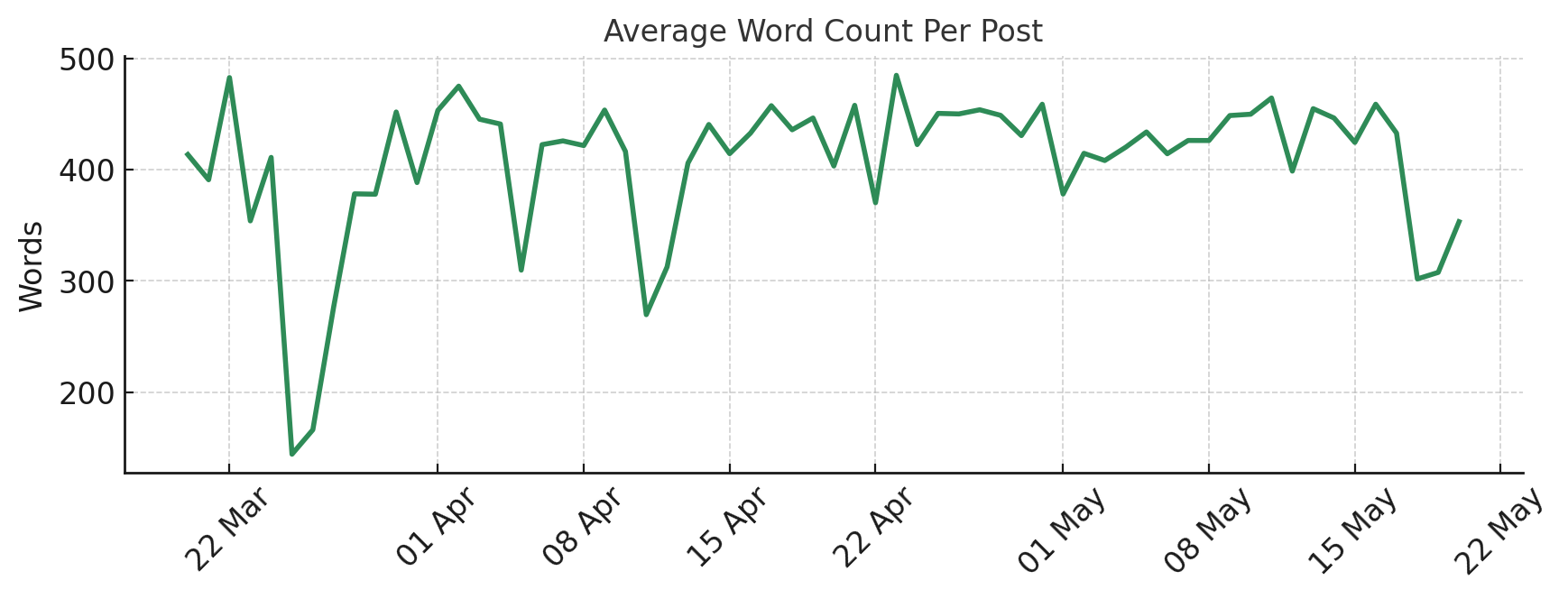 Average Word Count between 20th March and 20th May
I acquired this data in a HAR file (HTTP Archive), used a bit of Python, and maybe spent longer than I should have figuring out the JSON format. If you're interested, I am happy to share the Python to acquire data like this.
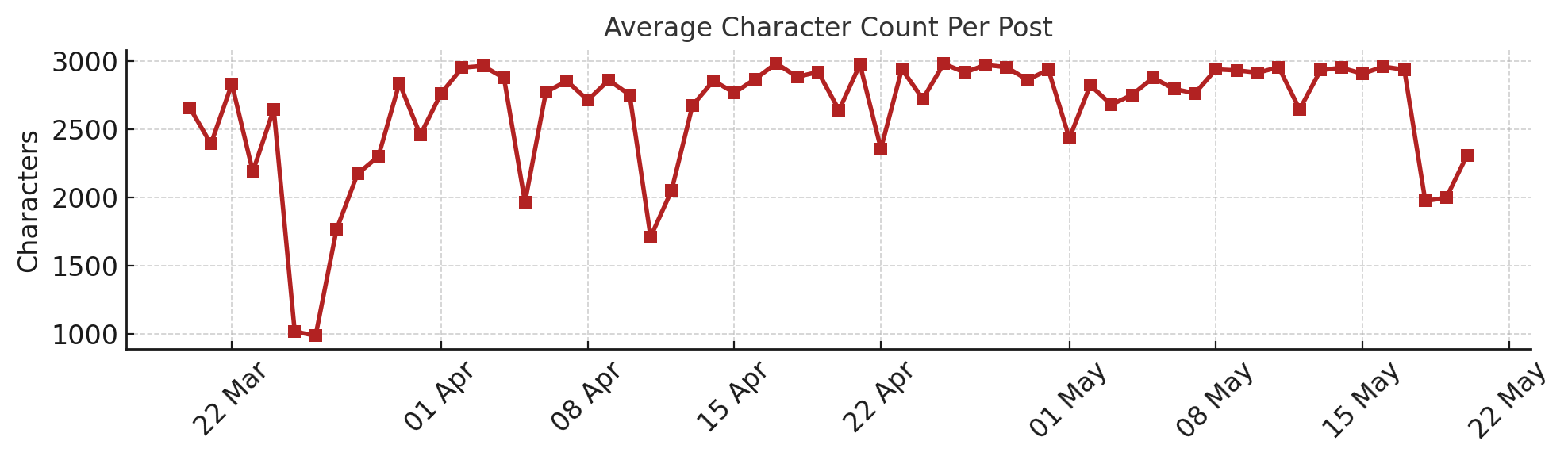 Average Character Count between 20th March and 20th May
Even with automation and scheduling tools, this is a serious volume of content. For comparison, the book “The Hobbit” has 95,356 words in it. In 2 months, this user has produced 107,454 words. That is a significantly impressive feat, out-writing Tolkien’s The Hobbit in 2 months while CEO of a startup. If we use Occam’s Razor to assess this, the most plausible explanation is that a significant portion of the content is AI-generated or AI-assisted. That would be fine…if not for one thing. This person also spends a lot of time criticising the very same tools they are potentially using. They’ve called out prominent figures in AI for ethical failings and moral shortcuts, all while their own content shows signs of being built with those same tools. Irony aside, it highlights something much bigger.
The real problem isn’t this individual. It’s the system that rewards and elevates this kind of behaviour. Because here’s what happens. Content (human or not) gets pumped out at volume. It hits the right emotional notes. It gets engagement. Likes go up. Follower counts rise. Then recruiters, investors, and professional communities start treating that influence as a proxy for insight. Suddenly, influence isn’t a side effect. It becomes a credential. A qualification. An important feature on the credibility checklist. This is where it gets dangerous. Oh, and the problem isn’t AI. AI is just the accelerant. It’s the water on the chip pan fire.
We are now using shallow, visible, easily gamed metrics to make deep, consequential judgments about intelligence, capability, leadership, and trust. If you genuinely believe in being “data-driven,” that should really start to concern you. Being data-driven doesn’t mean finding a number that flatters your decision. It doesn’t mean cherry-picking metrics to make your dashboard look tidy. It means asking the right questions of the right data before using it to decide anything.
Who collected this data, and how?
Am I seeing the raw data, or someone’s interpretation of it?
What’s missing from this dataset? And why might that matter?
What are all the possible explanations for this pattern...not just the one I want to be true?
Is this correlation dressed up as causation?
Is this signal or noise, and how can I tell?
If I act on this data, what are the consequences of it being wrong?
Who benefits if I trust this data without questioning it?
When influence starts to replace ability, and we stop asking those questions, we are no longer data-driven. We are data-distracted. We owe ourselves, and each other, better than that.